
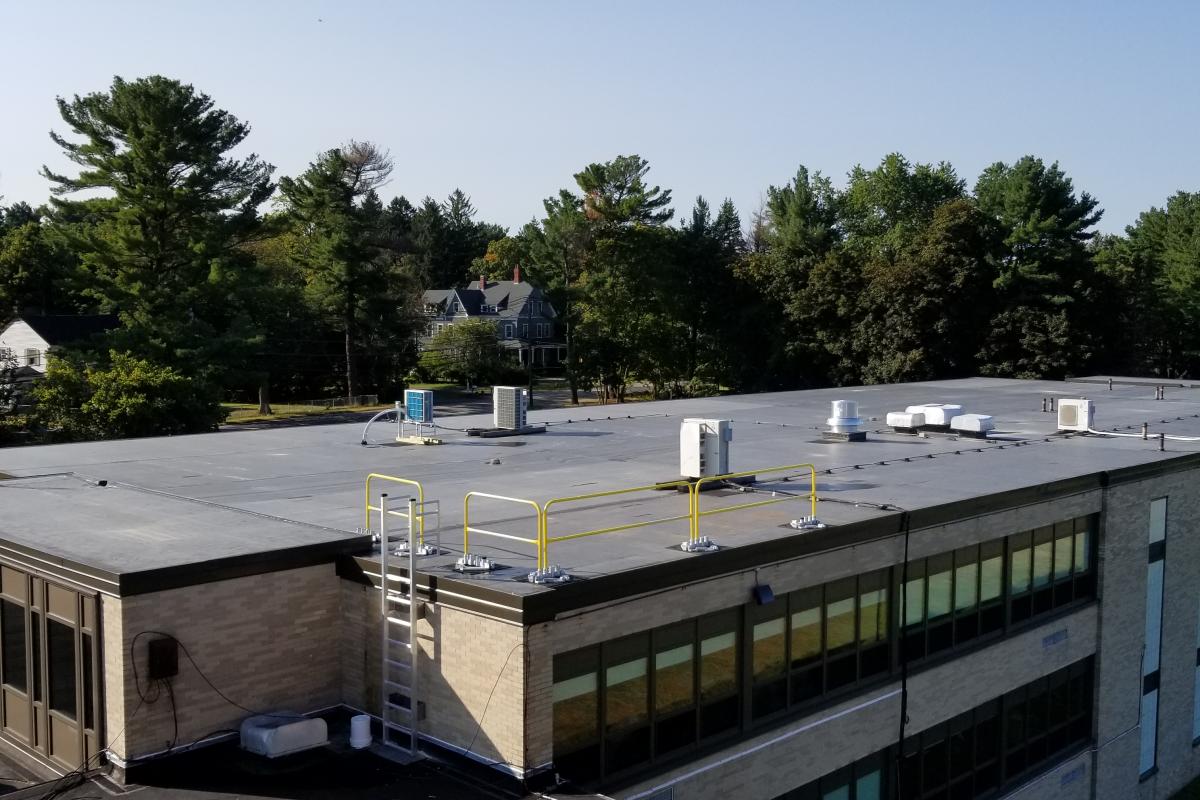
Commercial roof scope, inspection, access planning, and documentation for acrylic roof coatings.
San Francisco presents a government roofing market unlike any other in the country: a dense 7-by-7-mile city where virtually every municipal building carries some historic significance, where the combined city and county government operates as a single entity with procurement systems to match, and where seismic performance requirements, prevailing wage obligations, sustainability mandates, and preservation review all converge on every major capital project simultaneously. San Francisco City Hall - a beaux-arts masterpiece that survived the 1906 earthquake and the fire that followed, then required complete seismic base isolation in the 1990s - the San Francisco Civic Center Historic District, the San Francisco Public Library's branches in neighborhoods from the Excelsior to the Richmond, the San Francisco Fire Department's over 40 stations scattered across a topographically challenging city, and the Hall of Justice on Bryant Street all represent distinct roofing challenges that demand institutional experience at every level of project execution.
San Francisco's consolidated city and county government operates through the Department of Public Works for construction project delivery, with the Office of Contract Administration managing procurement for many capital contracts. The City's Human Rights Commission administers local business enterprise requirements - the LBE program - which establishes participation goals for local businesses and subcontracting requirements on city contracts. San Francisco's LBE program is one of the most extensive in California, with bid discounts for qualifying firms and mandatory subcontracting goals enforced through the OCA's compliance review. Federal projects involving San Francisco's infrastructure also trigger the California DVBE requirement. Contractors who have not engaged the LBE compliance process before bid submission will encounter disqualification on grounds that cannot be remedied after the fact. Pre-bid engagement with the HRC, identification of qualifying LBE subcontractors, and documentation of good-faith outreach are competitive necessities, not optional compliance exercises.
California's prevailing wage requirements apply to every San Francisco government roofing project, and the San Francisco Bay Area wage determinations for roofing classifications are among the highest in the state, reflecting the region's labor market conditions and strong union presence. The San Francisco Building and Construction Trades Council maintains active oversight of prevailing wage compliance on city projects, and reports of violations generate immediate investigation by the city's LBE and HRC staff and by the California DIR's Bureau of Field Enforcement. Electronic certified payroll through eCPR is mandatory, worker interviews are conducted routinely, and contractors who have documented violations in prior San Francisco projects face enhanced scrutiny on future work. Compliance infrastructure - a dedicated payroll manager who understands DIR requirements and can respond to audit requests within the timelines DIR specifies - is a prerequisite, not an option.
San Francisco's seismic requirements fundamentally affect roofing work on government buildings in ways that no other American city replicates. Following the 1989 Loma Prieta earthquake and the accelerated seismic upgrade programs that followed, many San Francisco government buildings underwent structural retrofits that affected roof deck connections, parapet seismic bracing, and mechanical equipment anchorage. Proposed reroofing systems must be evaluated for compatibility with existing seismic upgrades, and added dead load from new insulation or ballasted assemblies requires review by a structural engineer registered in California. San Francisco's building department - SFDBI - enforces seismic compatibility requirements on reroofing permits, and plan check submittals for government building reroofing projects on larger facilities require structural documentation that is more involved than most commercial roofing permitting anywhere else in the country.
The San Francisco Civic Center Historic District - encompassing City Hall, the War Memorial Opera House, the San Francisco Main Library, and several federal buildings - is one of the most significant concentrations of beaux-arts civic architecture in the United States. The California State Historic Preservation Office, the National Park Service (for federally owned buildings), and the San Francisco City Planning Department's Historic Preservation Program all provide oversight for alterations within the district. City Hall's distinctive roof and dome system require specialized consultation involving the DPW Bureau of Architecture, the SHPO, and in some cases the National Park Service. Contractors proposing roofing work anywhere within the Civic Center District must have navigated multi-agency preservation review before - the complexity of those consultations is not an environment for learning on the job.
San Francisco's sustainability requirements for city buildings are among the most demanding in the country, driven by the city's commitment to carbon neutrality and the San Francisco Environment Code. The city's Environment Department administers green building requirements that exceed CALGreen for city-owned facilities, including enhanced insulation requirements, mandated cool roof specifications, and green roof infrastructure provisions on certain building types. San Francisco's Stormwater Management Ordinance applies to impervious surface alterations above defined thresholds, and reroofing projects that trigger the ordinance must incorporate low impact development measures - including potentially vegetated roof components - to manage stormwater on site rather than directing it to the combined sewer system. The San Francisco Public Utilities Commission monitors stormwater compliance, and reroofing project permits can be conditioned on LID compliance demonstration.
San Francisco Fire Department's station network is one of the most constrained operational environments for roofing work in any American city. Stations are embedded in dense urban neighborhoods - North Beach, the Castro, the Mission, Hayes Valley - where staging is essentially impossible, where the public right-of-way cannot be blocked without SFMTA permits that require weeks of advance processing, and where neighbors file complaints about construction noise within hours. Fire stations must remain fully operational throughout construction, apparatus companies cannot be relocated during reroofing, and the close-quarter conditions mean that tearoff debris must be managed with a level of containment that's not required on suburban sites. Experienced San Francisco government roofing contractors have developed logistics systems - small-batch tearoff, daily waste removal, contained material hoisting - that allow work to proceed on these constrained urban sites without generating the community complaints that attract city council attention.
San Francisco's neighborhood library branches - the Excelsior Branch, the Noe Valley Branch, the Bernal Heights Branch, and dozens of others - are neighborhood institutions with deep community attachments. The branch library buildings range from Carnegie-era structures to mid-century modern designs to recent purpose-built facilities. The Carnegie branches that remain in service carry historic designations that require HPC review and SHPO consultation for exterior alterations, and the community engagement that surrounds reroofing of a beloved neighborhood library branch is intense by any standard. San Francisco's Branch Library Improvement Program, which delivered new or renovated library facilities across the city over a decade-long bond-funded program, created a cohort of modern branch buildings that are now approaching their first major reroofing cycles. Contractors who participated in the improvement program's original construction or early maintenance cycles have institutional knowledge of those buildings' systems that is genuinely valuable in procurement evaluations.
San Francisco's Hall of Justice on Bryant Street, currently awaiting replacement with a new Civic Center justice facility, and the existing criminal courts complex represent the most operationally sensitive government roofing environment in the city. Active courtrooms, jail facilities, and 24-hour law enforcement operations occupy the building continuously, and any roofing project that disrupts those operations encounters an institutional response that extends well beyond the DPW project manager. Security coordination for contractor access, tool accountability at secure facility perimeters, and emergency shutdown protocols for the rare weather event that requires immediate response are all documented requirements that government roofing contractors must address in their project execution plans before the first pre-bid meeting ends. San Francisco's justice facility roofing market rewards contractors who have earned institutional trust with the city's Real Estate Division and the Sheriff's Department over multiple project cycles.
Request A Roof Scope
Send the building location, roof concern, and access notes. We will respond with the next practical step.
Related Pages
Questions About Government and Municipal Building Roofing
What changes the scope?
Access, wet insulation, deck repairs, edge metal, drain work, occupied-building constraints, disposal, and code documentation can all change the final path.
Can the building stay occupied?
Often, yes. The scope still needs rules for loading, noise, odors, tenant notices, daily dry-in, and emergency contact responsibilities.
When is coating realistic?
A coating is realistic only when the roof is dry, cleanable, compatible, properly detailed, and still structurally sound.
What should ownership receive?
A usable roof file should include photos, observed conditions, assumptions, near-term repairs, capital triggers, and the recommended next step.