
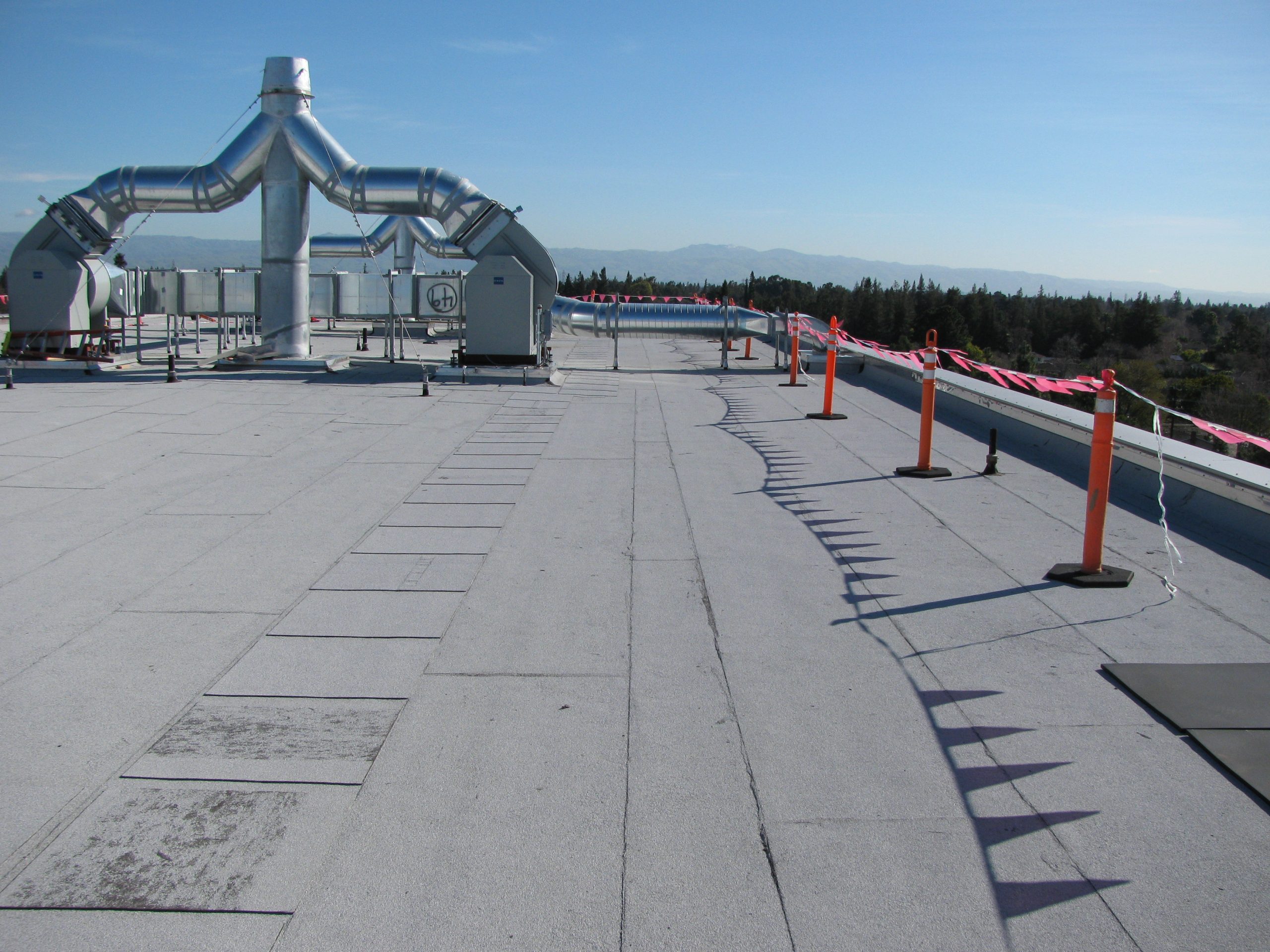
Occupied Building Re-Roofing in San Francisco, CA requires a phased work plan approved by the building owner before mobilization. Each phase defines the open roof area for that work day, the temporary protection strategy if weather interrupts the schedule, the access route that avoids tenant entrances and parking areas, and the daily dry-in standard that must be met before the crew leaves the site. For occupied building re-roofing in San Francisco, the dry-in requirement is non-negotiable: no open membrane section stays unprotected overnight.
OSHA 1926.502 fall protection requirements apply to every occupied building re-roofing project. Workers on low-slope roofs more than six feet above the lower level must be protected by guardrails, safety nets, or a personal fall arrest system. For occupied building re-roofing in San Francisco, the fall protection plan also has to account for the people below: tenant notifications, sidewalk protection at eave edges, and daily housekeeping to prevent debris from becoming a pedestrian hazard are all part of the scope before a nail gun fires.
Material staging for occupied building re-roofing requires site-specific coordination. Tear-off material cannot block tenant loading docks, fire exits, accessible parking spaces, or HVAC fresh air intakes. For occupied building re-roofing in San Francisco, we review the site plan before scheduling delivery, identify crane or forklift staging windows that minimize operational disruption, and establish a debris disposal sequence that keeps dumpsters from occupying tenant or customer spaces for more than one work day.
Contingency planning separates quality occupied building re-roofing from a project that becomes a tenant relations problem. A weather delay at the wrong moment in an occupied building re-roofing sequence can leave a building exposed overnight. We build contingency dry-in materials into the initial mobilization, keep the facility contact informed of forecast changes, and document every weather decision so the owner has a clear record of protective measures taken. Contact Commercial Roofing at or to discuss occupied building re-roofing for your San Francisco property.
Questions Owners Ask
We review tenant operations, loading dock schedules, access routes, forecast windows, and daily dry-in capacity to build a phase sequence that keeps the building protected and operations running.
Workers within six feet of an unprotected roof edge must be protected by guardrails, safety nets, or a personal fall arrest system. The fall protection plan is submitted before work begins.
We provide the building owner with a daily work summary, notify affected tenants in advance of work near their spaces, and designate a single point of contact for questions during the project.
Pre-staged contingency dry-in materials are deployed to protect any open section. The facility contact is notified, and the phase plan is adjusted to keep the building protected while rescheduling lost time.
Can work happen while the building remains occupied?
Often, yes. We still need a plan for noise, odor, loading, tenant notices, pedestrian controls, daily dry-in, and emergency contact rules before work begins.
How do we know whether a coating is realistic?
A coating is realistic only when the roof is dry, cleanable, compatible, properly detailed, and still structurally sound. Adhesion, moisture, slope, and seam condition decide that.
Will Title 24 affect the roof scope?
It can. Nonresidential reroofing, recover, or recoating work may require cool-roof documentation, reflectance, thermal emittance, SRI, or insulation review depending on the project path.
What should ownership receive after the roof walk?
A useful roof file includes photos, observed conditions, active leak notes, near-term repairs, capital triggers, access assumptions, exclusions, and the recommended next step.
Request A Roof Scope
Send the building location, roof concern, and access notes. We will respond with the next practical step.
Related Pages
Questions About Occupied Building Re-Roofing
What changes the scope?
Access, wet insulation, deck repairs, edge metal, drain work, occupied-building constraints, disposal, and code documentation can all change the final path.
Can the building stay occupied?
Often, yes. The scope still needs rules for loading, noise, odors, tenant notices, daily dry-in, and emergency contact responsibilities.
When is coating realistic?
A coating is realistic only when the roof is dry, cleanable, compatible, properly detailed, and still structurally sound.
What should ownership receive?
A usable roof file should include photos, observed conditions, assumptions, near-term repairs, capital triggers, and the recommended next step.