
The Roofing Half of a Commercial Solar Project in San Francisco
A solar installer sells you panels. Nobody on that crew is responsible for the membrane those panels are bolted to, and that gap is where we do our work. We are roofers, and on a solar job our job is to make sure the array gets mounted in a way that does not turn your roof into a leak the day the warranty matters. That means deciding how the racking attaches, confirming the structure can carry the load, choosing a membrane that plays nicely with everything sitting on top of it, and getting the paperwork lined up so two trades do not spend the next decade blaming each other for water in the building.
San Francisco pushes commercial owners toward rooftop PV harder than most cities. PG&E's commercial electricity rates run well above the national average, so the payback math on a large array is genuinely attractive here. The city's Better Roofs ordinance requires most new and majorly renovated commercial buildings to dedicate roof area to solar or living roof, which has put PV into the planning conversation for a lot of owners who were not thinking about it. And the demand is concentrated in exactly the building types that have the roof area for it: the warehouse and flex stock along Evans Avenue and Jerrold Avenue in the Bayview, the larger floorplates around Showplace Square and the Design District, and the life-science buildings going up around Mission Bay where tenants want a clean-energy line in their lease.
Start With How Much Life the Roof Has Left
Before anyone talks panel counts, we want to know the age and condition of the membrane underneath. This is the question that decides whether the whole project is a good idea right now. A modern array is built to produce for twenty-five years or more. If you mount it on a roof with eight years of service life left, you have guaranteed yourself an expensive problem: when that roof needs to be replaced, the entire array has to be detached, stored, and reinstalled, and detach-and-reset on a commercial system routinely runs well into five figures. That bill can wipe out years of energy savings.
So we give you an honest number. If the roof has fifteen or twenty good years in it, mounting an array on the existing surface is sensible. If it is closer to the end, the right sequence is to reroof first and set the array on a fresh membrane with a fresh warranty clock. Owners do not always want to hear that, but it is far cheaper to hear it now than after the panels are up and the roof starts failing underneath them.
How the Racking Attaches, and Why Every Penetration Is a Flashing Detail
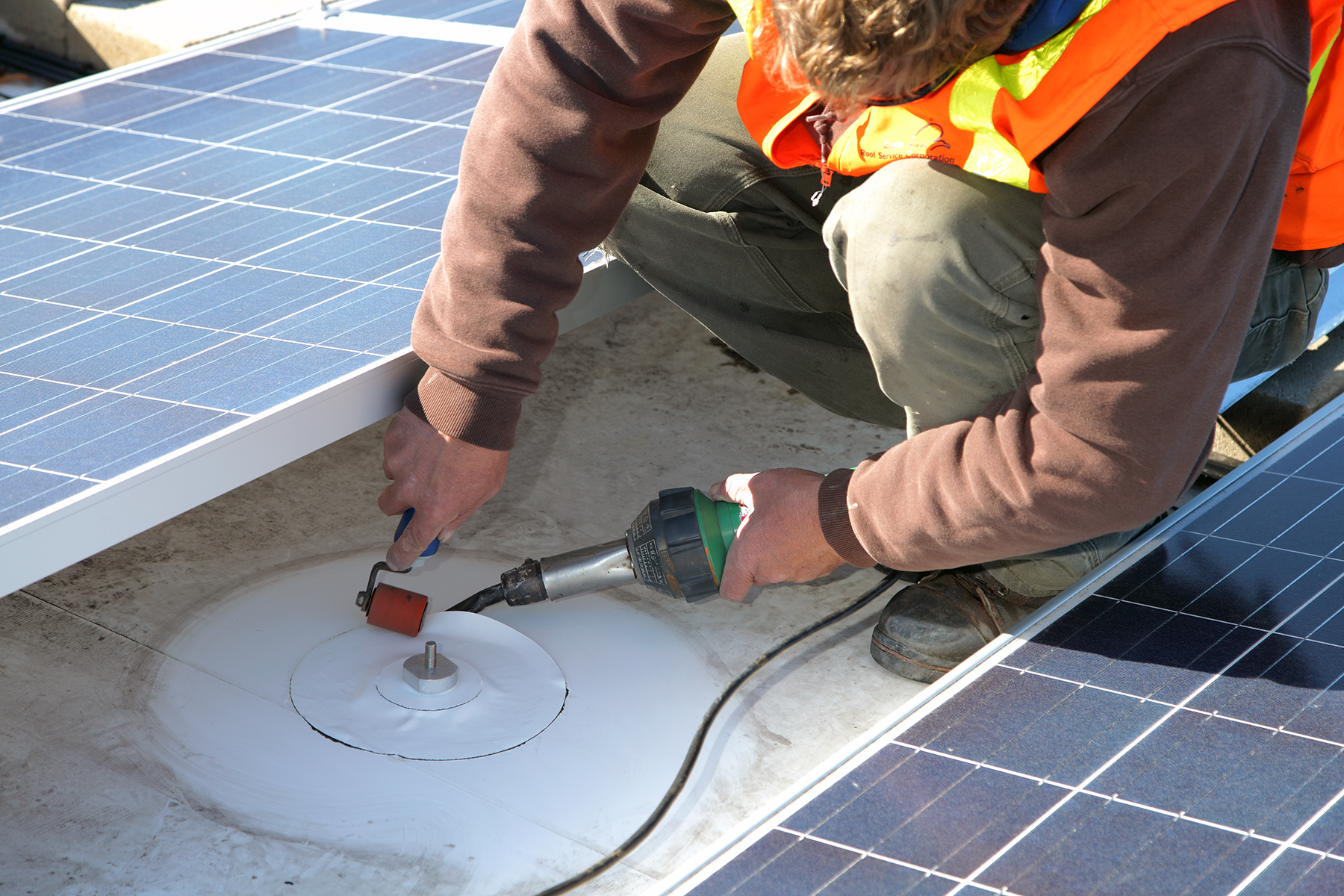
There are two basic ways to hold an array down, and each one hands the roof a different problem. Mechanically attached racking drives fasteners and standoffs through the membrane on a dense grid. Every one of those points is a hole in your roof, and every hole is either flashed to the membrane manufacturer's specification or it is a future leak. The most common failure we are called back to fix is a solar crew that sealed a penetration with a glob of pourable sealant instead of a hot-air-welded target patch and an approved standoff. The redo costs more than doing it right would have. The conduit runs that carry power from the array back to the electrical room cross the membrane too, and conduit clipped flat to the roof surface saws into it with every thermal cycle. We locate the penetrations, weld the flashings ourselves, and set proper pipe supports before the electrician pulls wire.
Ballast, Structural Weight, and the Wind Off the Bay
Ballasted racking skips the penetrations and holds the array down with concrete pavers instead. That trades a flashing problem for a weight problem. A lot of San Francisco's commercial building stock, especially the older warehouses in the Bayview and Dogpatch, was framed to mid-century load assumptions, and a ballast layout that looks fine on a spec sheet can exceed what the deck and joists were designed to carry. The city's wind exposure makes it sharper. Buildings near the waterfront and on exposed hills see real uplift, and the wind code drives up the ballast count at the perimeter and the corners of the array, which adds even more weight exactly where the structure is most loaded. We bring a structural engineer into the conversation early so this gets resolved during design instead of during plan check.
Choosing a Membrane the Array Can Live On
The membrane under a solar array is not just a surface to bolt to. A white reflective single-ply runs cooler in the sun, and panels produce more when they run cooler, since module output drops as cell temperature climbs. For that reason we usually specify a 60-mil white TPO or PVC under commercial arrays, both because of the reflectivity and because the seams are weldable and repairable when a crew needs to get under the panels years later. There is also a compatibility question that a solar EPC is simply not looking for: certain racking feet, walk pads, and membrane chemistries do not get along, and plasticizer migration or chemical contact can degrade the membrane where they touch. Catching that is roofing work, and getting it right is what keeps the system serviceable for the life of the array.
Leaving Yourself a Way to Service the Roof
An array is not install-and-forget. Inverters fail, strings drop offline, modules get washed, and people will be up on that roof for the next twenty-five years. We build protected walkways out of welded walk pads so service traffic does not grind down the field membrane, and we keep clear, mapped paths to every drain, scupper, and rooftop unit so the roof stays drainable and inspectable underneath the panels.
Coordinating Your Roofing Warranty With the Solar Installer
This is where a project ends clean or ends in a fight. Most major single-ply manufacturers will keep their system warranty in force over a solar installation only if the attachment details, walkway protection, and penetration flashings meet their published requirements, and on larger jobs only if their field rep reviews the work before the array goes on. We manage that review. We document the details to the manufacturer's standard and we sequence the trades so the membrane is installed and inspected before any racking lands, and so the conduit penetrations get flashed by us rather than improvised by the electrician. We do not sell solar systems, so our only stake in the project is a roof that performs and a warranty that survives. The owner we want to avoid being is the one holding a voided membrane warranty and a detach-and-reset bill the first time it rains hard.
How We Run a Solar-Plus-Roofing Job
- Assess the existing membrane and put a remaining-service-life number in writing before any solar contract is signed.
- Recommend reroof-first or mount-on-existing based on that number, not on the solar crew's schedule.
- Confirm structural capacity for ballast or fastening, with real attention to San Francisco's waterfront and hilltop wind exposure.
- Specify a compatible reflective membrane and the manufacturer-approved attachment and standoff details.
- Set and flash every array and conduit penetration ourselves, ahead of the solar crew.
- Build protected service walkways and keep all drainage paths clear under the array.
- Run the manufacturer warranty review and sequence the trades so coverage stays intact.
Send us the building location, the existing roof type if you know it, and the size of the array you are weighing, and we will tell you plainly whether the roof is ready for solar or needs work first. That answer costs nothing now and saves a great deal later.
Questions About Commercial Solar Roof Integration
What changes the scope?
Access, wet insulation, deck repairs, edge metal, drain work, occupied-building constraints, disposal, and code documentation can all change the final path.
Can the building stay occupied?
Often, yes. The scope still needs rules for loading, noise, odors, tenant notices, daily dry-in, and emergency contact responsibilities.
When is coating realistic?
A coating is realistic only when the roof is dry, cleanable, compatible, properly detailed, and still structurally sound.
What should ownership receive?
A usable roof file should include photos, observed conditions, assumptions, near-term repairs, capital triggers, and the recommended next step.