
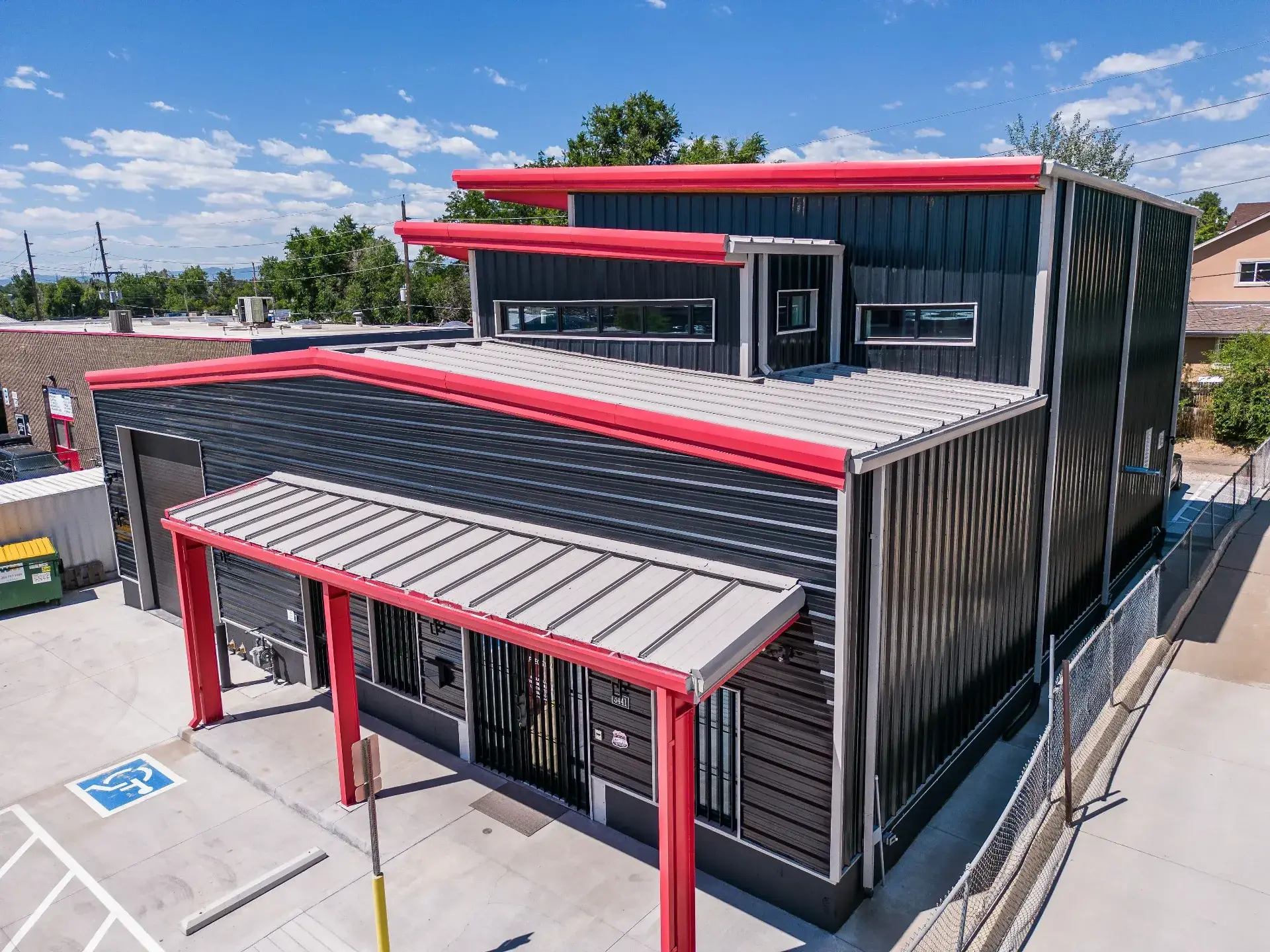
Roofing for tunnels, in-bay autos, and self-serve washes built to survive the steam, detergents, and canopy stress that come with the business.
Why a car wash roof fails faster than the building next door
A car wash is one of the few commercial buildings where the roof is attacked from below as hard as it is from above. Every wash cycle fills the tunnel with hot mist carrying detergent, tire shine, drying agents, and rust inhibitor. That vapor rises, hits the underside of the deck, and condenses on steel decking, fasteners, and the back of the insulation. From inside the equipment room and the tunnel itself, a roof can be rotting out years before a single stain shows on the ceiling. We treat the deck and the membrane as two separate exposure problems, because on a wash they are.
We work washes all over San Francisco and the close-in submarkets that feed it: the Bayshore Boulevard corridor down toward Visitacion Valley, the auto-service strip along South Van Ness and Mission Street, the gateway sites near the 101 and 280 interchanges, and the express tunnels that have gone in along Geneva Avenue and out toward Daly City and Brisbane. These are high-throughput sites. A express tunnel near a freeway on-ramp can cycle hundreds of cars on a clear weekend, and clear weekends in this city often follow a damp marine layer that never fully burns off. That swing from saturated morning air to dry afternoon sun is exactly the cycle that drives moisture in and out of a poorly detailed roof assembly.
The tunnel bay is the part that matters most
The roof directly over the wash tunnel takes the worst of it. We usually steer tunnel bays toward a thicker PVC membrane rather than TPO or EPDM, because PVC holds up better against the alkaline detergents and the wax and solvent compounds in a modern wash menu. A fully adhered install matters here too, not just for wind, but because it eliminates the air pocket under the sheet where tunnel vapor likes to collect. We look at the actual chemical program a site runs before we commit to a membrane, because a hot-wax express tunnel and a basic friction wash are not the same exposure.
Fasteners are the quiet failure point. Standard coated screws and plates corrode quickly in a tunnel ceiling environment, so on the equipment room and tunnel zones we move to a heavier corrosion-rated fastener and, where the structure allows, an adhered assembly that keeps metal out of the wet zone entirely. We also pull a core sample on any reroof so we can see what the existing deck looks like from the topside before we price the job. On older Bayview and Mission-corridor washes, the deck has often lost real section to rust, and that changes the scope.
Exhaust fans, blowers, and the penetration problem
Washes run big rooftop exhaust to pull steam and chemical vapor out of the tunnel, plus blower equipment and HVAC for the lobby and equipment room. Every one of those is a penetration sitting in the most aggressive part of the roof. We oversize the curbs, detail the flashing for continuous airflow and chemical contact, and treat each one as its own assembly rather than wrapping them all in a generic boot detail. Where an exhaust stack drips condensate, we account for that runoff so it is not eating the membrane two feet downstream.
Canopies and the in-bay versus express split
Vacuum canopies and the customer canopy on the exit side are a separate roof in practice. They take vehicle exhaust, overspray from tire dressing, and full outdoor thermal cycling, and the most common chronic leak we find on a San Francisco express site is the canopy-to-building transition and the canopy drain connection. We re-flash those joints, check the gutters and downspouts, and tie the canopy drainage back into a path that actually clears. In-bay automatics and self-serve bays carry less vapor load than a full express tunnel, but they tend to pond water over the equipment bays because the original drainage was never tapered correctly, so on those we look hardest at slope and drain placement.
Working around your wash hours
Most washes in this market run seven days a week, and the busy window is daylight on a dry day. We plan tunnel roof work for the early-morning or after-close window so the wash equipment is down, and keep exterior building and canopy work to controlled hours with traffic management that keeps cars clear of the crew. The goal is a watertight roof at the end of every shift so you are never choosing between staying open and staying dry.
Reclaim equipment, ventilation, and the equipment room roof
The equipment room is its own roofing problem. Water reclaim systems, pumps, and chemical storage put humidity and chemical vapor into that space all day, and the roof above it sees a milder version of what the tunnel ceiling gets. We make sure that room is ventilated through properly flashed rooftop penetrations and that any chemical exhaust is detailed for what it carries, because corrosion in the equipment room roof is slow and easy to miss until a pump or a controller takes water damage. Tying the equipment room ventilation and the tunnel exhaust into a coherent plan is part of how we keep the whole building's roof from aging unevenly.
Common questions about car wash roofing
What membrane do you put over a wash tunnel?
Usually a 60-mil PVC, fully adhered or fleece-backed. PVC stands up to the alkaline detergents and wax compounds far better than TPO or EPDM, and the adhered install removes the vapor pocket and the fastener field from the wettest part of the roof. The lobby and equipment room can run a standard single-ply.
Will chemical exposure void my roof warranty?
It can. Most single-ply warranties carry chemical-exposure exclusions in their standard language. Before we spec a tunnel membrane we confirm with the manufacturer that your specific wash chemistry is compatible and that the warranty covers it. Some manufacturers offer chemical-exposure or car-wash-specific warranties, and we pursue those where they apply.
Can you reroof while we stay open?
Yes, with sequencing. Tunnel work happens in your closed window; canopy and exterior building work happens during the day with traffic control. Each section is dried in before we leave.
Do you handle the vacuum and customer canopies?
Yes. Canopy covers, the customer waiting canopy, gutters and downspouts, and the canopy-to-building flashing are all part of the scope assessment, not an add-on we discover later.
Request A Roof Scope
Send the building location, roof concern, and access notes. We will respond with the next practical step.
Related Pages
Questions About Car Wash Roofing
What changes the scope?
Access, wet insulation, deck repairs, edge metal, drain work, occupied-building constraints, disposal, and code documentation can all change the final path.
Can the building stay occupied?
Often, yes. The scope still needs rules for loading, noise, odors, tenant notices, daily dry-in, and emergency contact responsibilities.
When is coating realistic?
A coating is realistic only when the roof is dry, cleanable, compatible, properly detailed, and still structurally sound.
What should ownership receive?
A usable roof file should include photos, observed conditions, assumptions, near-term repairs, capital triggers, and the recommended next step.